

Views: 0 Author: Site Editor Publish Time: 2025-12-13 Origin: Site


In the rapidly evolving textile machinery sector, 2025 marks a decisive shift towards fully automated quilting machines. At Yiboda Industrial Co., Ltd., we have observed this transformation closely, and we believe that embracing automation brings significant advantages — especially in cost performance ratio, productivity, and long term value. In the following, we outline why automated quilting machines have become the new standard, what to look for when evaluating them, and how this shift positions businesses for future growth.
Recent industry research shows that the global quilt market continues to expand steadily. Rising consumer demand for quilts — driven by both home textiles and industrial usages (e.g., mattress manufacturing, upholstery, automotive textiles) — pushes manufacturers to increase output, maintain quality, and shorten lead times.
Simultaneously, advancements in machine technology, especially computerized and multi needle quilting machines, have gained prominence. Projections indicate that the market for computerized quilting machines will continue to grow at a compounded annual growth rate (CAGR) of around 5–7% through the rest of the decade.
This dual dynamic — rising demand + advancing technology — makes 2025 a pivotal year for quilting enterprises: those adopting automation now stand to gain a significant competitive edge.
At Yiboda, we view fully automated quilting machines as a game-changing investment for businesses in the quilting, textile, and upholstery industries. While the initial cost may be higher than traditional manual or mechanical machines, the superior value these machines offer over their lifecycle makes them a strategic investment that can dramatically improve productivity, quality, and overall cost-efficiency. Here’s a deeper look at why automated quilting machines stand out.
One of the most significant advantages of fully automated quilting machines is their ability to drastically reduce manual labor requirements. These machines incorporate computerized controls for stitch patterns, fabric feeding, and multi-needle operation, allowing for faster and more efficient production compared to manual or hand-guided methods.
By automating repetitive tasks, the reliance on labor-intensive work is greatly reduced. Fewer operators are needed to run the machines, which cuts down on labor costs. For businesses that produce quilts at a large scale — such as for mattresses, beddings, and automotive upholstery — shifting from manual labor to automated quilting can lead to substantial savings over time. The reduction in human error and the ability to produce large volumes of quilts more quickly allows manufacturers to keep up with growing demand while keeping operating expenses in check.
Precision is key when it comes to quilting. Consistent stitching, perfect alignment, and minimal errors are what separate a premium product from a substandard one. Automated quilting machines use technologies such as laser-guided or CAD-guided stitch control, which ensures a uniform output across large production runs. The precision offered by these machines helps eliminate common issues that arise in manual quilting, such as uneven stitching, missed stitches, or misalignment.
For companies, the quality improvements from automation can be significant. Many users report up to a 45% reduction in defects after switching to automated quilting machines. This increased consistency means reduced material wastage, as there is less scrap fabric and fewer reworks required. Additionally, the reduction in defects translates into fewer customer complaints, leading to improved customer satisfaction and lower returns. All these benefits contribute to overall cost savings and higher product quality, which can enhance a company’s reputation in the competitive quilting market.
Long-arm or multi-needle automated quilting machines offer an expanded workspace and the ability to produce a high throughput of quilts in a short period. This makes them particularly well-suited for heavy-duty industrial use. Unlike traditional home-use machines or manual quilting, long-arm automation can cut production time significantly.
While automated quilting machines have a higher upfront cost compared to entry-level mechanical machines, the combination of reduced labor costs, lower waste, improved quality, and faster throughput results in a compelling return on investment (ROI).
Modern automated quilting machines are not only designed with efficiency in mind but also with sustainability. Many of these machines integrate energy-efficient components and smart controls that optimize fabric consumption and reduce waste. For companies that prioritize eco-conscious manufacturing, investing in automated quilting machines aligns with their sustainability goals.
Given the benefits, not all quilting machines are created equal. Selecting the right model for your business involves assessing several cost-performance criteria. We recommend evaluating prospective machines against the following dimensions:
Evaluation Dimension | What to Pay Attention To | Why It Matters |
Machine Type & Capacity | Single needle vs multi needle; long arm vs mid/short arm; automated vs manual controls | Determines throughput, capability to handle large quilts or heavy materials |
Stitch Precision & Control Features | CAD/guided stitch patterns, computerized controls, tension adjustment, automated feed | Affects quality, defect rates, consistency, and waste reduction |
Operational Cost Efficiency | Energy consumption, maintenance requirements, downtime risk, material usage efficiency | Influences ongoing cost savings and ROI |
Operator Skill Requirements | Complexity of operation, training needs, user interface, support documentation | Impacts ease of adoption, error rate, and reliability |
Total Cost of Ownership (TCO) | Upfront cost, maintenance, labor savings, throughput gains, waste reduction, scrap rate | Helps compute realistic ROI and long-term value |
Flexibility & Scalability | Ability to quilt varied materials, adjust stitch patterns, scale output, handle batch orders | Supports business growth and product diversification |
By using this framework, businesses can compare different machines apples-to-apples — making decisions based on long-term operational value rather than short-term acquisition cost.
The shift toward automation in quilting machines is not happening in isolation. Several broader industry trends reinforce this direction:
AI and Smart Automation: Modern computerized quilting machines are beginning to integrate AI-based pattern recognition and automated maintenance alerts. This reduces human oversight, further lowers error rates, and supports predictive maintenance.
Sustainability Focus: As consumers increasingly demand eco-friendly products and manufacturers seek to reduce waste and energy consumption, automated machines that minimize fabric waste and energy use become more attractive.
Rising Industrial Demand: Industries such as mattress manufacturing, automotive upholstery, and home textiles are expanding — driving demand for efficient, high-volume quilting solutions.
Global Market Growth: The computerized quilting machine segment is projected to grow significantly over the next decade, offering long-term market stability for early adopters.
These trends suggest that companies investing in automated quilting equipment today are positioning themselves ahead of the curve — both technologically and commercially.
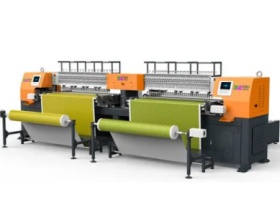
At Yiboda Industrial Co., Ltd., we have embraced fully automated quilting machines not just as tools, but as strategic assets. Here’s why we take this stance:
We believe that cost-performance is more than price — it’s about durability, throughput, waste reduction, and long-term operational savings.
We value consistent quality — our clients expect flawless stitching and uniformity, which automated machines reliably deliver.
We anticipate growth in demand — as the quilt, mattress, upholstery, and textile industries expand, we want to be ready with efficient, scalable production capacity.
We are committed to sustainability and efficiency — modern automated machines align with our responsibility toward environmental footprint reduction and resource efficiency.
Because of these beliefs, we carefully select and deploy automated quilting machines that meet our internal benchmarks. Our experience shows that automation isn’t just a trend — it’s a necessity for competitive manufacturing in 2025 and beyond.
That said, adopting automated quilting machines does require consideration. Some of the common pitfalls include:
High upfront investment — automated machines cost more initially than mechanical ones. However, evaluating total cost of ownership (TCO) and projected ROI helps justify the expenditure.
Need for trained operators — complexity increases compared to manual machines; appropriate training and documentation are critical.
Maintenance and downtime risk — computerized systems can require specialized maintenance. Choosing machines designed with reliability, and having spare parts/in-house maintenance capacity, mitigates this risk.
Over automation without flexibility — some highly specialized machines may lack flexibility for custom runs or unusual materials. Selecting machines with configurable settings helps preserve versatility.
We recommend potential customers run a cost-benefit analysis or pilot project to assess suitability before scaling up production.
The quilting industry in 2025 is at a turning point. As demand grows and technology advances, the shift to fully automated quilting machines is more than a trend — it’s a smart, strategic move. From productivity gains, quality improvements, and cost savings to sustainability and future readiness, automated machines deliver superior value.
We at Yiboda Industrial Co., Ltd. have already embraced this future. Based on our experience, we strongly encourage businesses — whether you are in textile manufacturing, mattress production, upholstery, or custom quilting — to consider upgrading to fully automated quilting machines. If you are interested in learning more about how these machines could benefit your operations, we are ready to provide professional guidance and reliable solutions.
Contact us today to explore how automation can transform your quilting production and secure a competitive edge in the evolving market.


