

Views: 0 Author: Site Editor Publish Time: 2025-12-22 Origin: Site


For textile manufacturers and bedding brands, the choice between quilting patterns is rarely just an aesthetic preference. It represents a fundamental production dilemma: balancing the high velocity of continuous output against the perceived luxury value of Tack & Jump designs. This decision dictates everything from daily production limits and maintenance cycles to the final pricing tier of your mattress or bedding line. While one method maximizes linear yardage, the other elevates shelf appeal through intricate, embroidery-like detail.
Understanding the mechanical realities of industrial Quilting Machines is essential for calculating true ROI and determining total cost of ownership. A mismatch between your machine's capabilities and your market positioning can lead to bottlenecked production lines or products that fail to justify their price point. In this guide, we break down the operational differences, cost implications, and durability factors of both styles. You will learn how to align your equipment procurement strategy with your specific business model, ensuring your manufacturing floor serves your financial goals effectively.
Speed vs. Premium: Continuous quilting offers maximum linear yardage per hour, while Tack & Jump creates the high-loft visuals associated with luxury pricing.
Structural Integrity: Continuous patterns provide superior layer stability and wash durability; Tack & Jump prioritizes loft and design complexity over structural binding.
Machine Capabilities: Not all quilting machines handle Tack & Jump efficiently; it requires specific trim-and-restart functionality that impacts maintenance cycles.
The "Hybrid" Reality: Modern manufacturing often requires multi-needle machines capable of switching modes to service different SKU tiers.
To understand the output, you must first understand the engine. The fundamental difference between continuous and Tack & Jump (T&J) quilting lies in the movement of the sewing head and the continuity of the thread supply. While both styles may utilize similar base frames, the software logic and mechanical actions differ drastically during operation.
Continuous quilting is exactly what it sounds like: an unbroken path of stitching. The machine architecture is designed for flow. In this mode, the needle bars and rollers work in perfect synchronization to feed fabric through the machine while the sewing heads execute a pattern that repeats seamlessly along the length of the roll.
The "Unbroken Path"
The sewing head moves in a 360-degree range, or the fabric moves in conjunction with a fixed needle bar, creating interlocking patterns. These designs—ranging from simple waves to complex geometrics—never require the machine to sever the thread within the pattern block. Because the thread remains continuous, the machine maintains a consistent RPM (revolutions per minute). There are no pauses for trimming, tying off, or repositioning.
Multi-Needle Efficiency
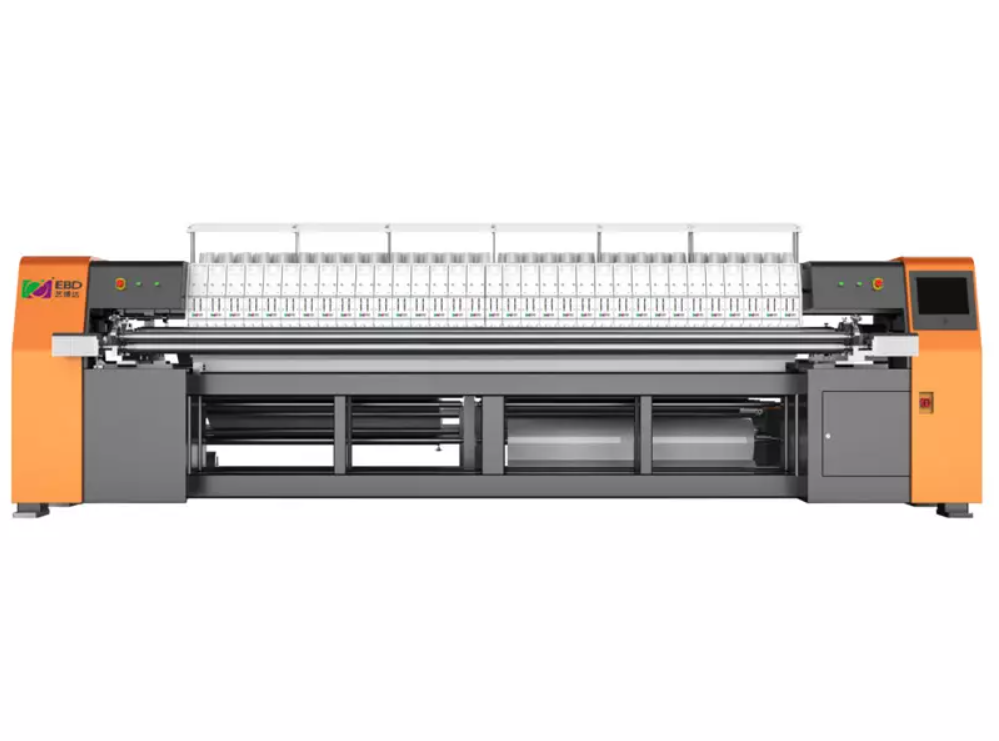
High-volume manufacturing relies heavily on Continuous Quilting Machines. These units utilize synchronized needle bars spanning the full width of the fabric roll. Whether you are running a 90-inch or 120-inch width, all needles fire simultaneously. This creates a dense, uniform web of stitches that locks the quilt sandwich (top fabric, batting/foam, and backing) together securely. The throughput focus here is absolute; the machine eats fabric at a constant rate, making it the preferred choice for high-volume orders.
Tack & Jump introduces a layer of mechanical complexity that fundamentally alters the production rhythm. It mimics the look of hand-tufting or embroidery by creating isolated islands of design rather than a connected web.
The Stop-and-Go Process
This process is physically demanding on the hardware. The sequence follows a strict loop:
Stitch (Tack): The needles sew a specific design element, such as a rosette or a centered logo.
Trim: The machine stops, and automatic trimmers cut the top and bottom threads.
Move (Jump): The fabric or head moves to the next coordinate without stitching.
Restart: The needles penetrate the fabric again to begin the next pattern.
Hardware Requirements
Not every machine can perform this effectively. T&J requires independent needle control (or select needle bar engagement) and highly reliable automatic thread trimmers. If a trimmer fails to cut cleanly, the thread drags across the "jump" space, ruining the aesthetic and requiring manual cleanup. Furthermore, the physics of "jumping" inherently reduces output. Every time the machine stops to trim and move, you lose production time. We call this "dwell time," and in T&J operations, it accumulates significantly over an eight-hour shift.
The mechanical differences directly translate into visual differences. These visual cues are what consumers use to judge the value of a mattress or comforter before they even touch it. Manufacturers must decide which "look" aligns with their brand promise.
The Luxury Illusion
Tack & Jump is the standard for the luxury tier. By leaving large areas of the fabric unquilted between the pattern islands, the material is allowed to puff up. This creates "loft." The visual depth created by high-loft T&J patterns suggests a thicker, softer, and more expensive product. It mimics the deep tufting found in heritage furniture and artisanal bedding.
Economy vs. Mid-Range
Conversely, continuous patterns tend to flatten the material. Because the stitch lines are connected and often denser, they compress the batting more uniformly. This results in a lower profile. Standard continuous patterns—like the ubiquitous "onion" or distinct diamond shapes—are associated with entry-level mattresses, mattress protectors, and functional outerwear. While they look neat and tidy, they rarely convey "opulence" to the average consumer.
Pattern Complexity
If your design team demands centered motifs, such as a brand logo in the middle of a panel or disconnected flowers, T&J is the only option. Continuous feeds are restricted to repeating linear designs. You cannot isolate a single geometric shape in the center of a bed using a continuous path without running a thread line to get there.
Fabric Compatibility
Your choice of face fabric also dictates the method. Continuous quilting is forgiving. It handles "busy" prints and lower-grade fabrics well because the consistent stitching distracts the eye. Tack & Jump is more ruthless. Because of the open spaces (jumps), the fabric quality is on full display. Furthermore, the needle penetrations at the start and stop points of a jump can be visible if the fabric weave is too loose. High-quality knits or heavy damasks are often required to hide these entry points effectively.
Evidence-Based Comparison: Visual Impact
| Feature | Continuous Quilting | Tack & Jump Quilting |
|---|---|---|
| Visual Profile | Flat, compressed, uniform | High-loft, deep sculpt, puffy |
| Consumer Perception | Functional, durable, economy | Luxurious, plush, premium |
| Pattern Type | Interlocking geometrics, waves | Isolated motifs, logos, floating designs |
| Batting Compression | High (reduces overall thickness) | Low (maximizes loft potential) |
Aesthetics sell the product, but durability keeps the return rates low. The structural impact of the quilting style on the "sandwich"—the layers of fabric and fill—is often overlooked during the design phase.
Layer Shifting
Continuous quilting acts as a stabilizer. By applying uniform tension across the entire surface area, it locks the batting and foam to the shell fabric securely. This is crucial for products that undergo mechanical stress, such as machine-washable comforters or utility bedding. The dense stitching prevents the internal fibers from bunching up or shifting after a wash cycle.
Loft Retention
Tack & Jump prioritizes softness over stability. Because it leaves large areas unquilted, the internal batting has more freedom to move. Over time, or after repeated washing, this can lead to fiber migration. On a mattress, which is rarely washed, this is less of an issue. However, for a washable duvet, a T&J pattern with wide spacing risks the internal fill separating, creating lumpy, uneven spots.
Snag Risks
Every time a machine stops and cuts a thread in T&J quilting, it leaves a "tail" (even if short) and a tie-off point. A complex pattern might have hundreds of these start/stop points across a single panel. Each one represents a potential weak point. If the machine fails to back-tack correctly, the thread can unravel. Additionally, exposed threads on the surface are snag hazards. Continuous patterns have significantly fewer start/stop points, reducing the probability of unraveling.
Seam Stress
Continuous patterns distribute mechanical stress evenly across the fabric. When a user sits on the mattress or pulls the comforter, the tension is shared by thousands of connected stitches. In T&J, the stress is concentrated at the "tack" points. If the fabric is weak, the thread can pull through the material at these isolated anchor points, leading to tears or holes over years of use.
For the plant manager, the battle between patterns is calculated in dollars and cents. The operational costs of running T&J are inherently higher than continuous modes.
Yardage Per Hour
Speed is the primary advantage of continuous modes. Continuous quilting machines typically deliver 30% to 50% higher output than T&J modes on the same hardware platform. The reason is simple: zero dwell time. The machine does not stop to think, trim, or jump. It runs at a consistent high RPM. For a factory needing to produce 500 mattress panels a shift, continuous quilting makes hitting that target significantly easier.
Thread Consumption
Waste is another factor. Tack & Jump generates more thread waste. Every trim sequence creates a small tail of top and bottom thread that is discarded or hidden inside the product. Furthermore, the frequent tie-offs consume more bobbin thread per square yard of finished design compared to the efficient, linear consumption of continuous patterns.
Wear Parts
Tack & Jump places heavy stress on specific machine components. The automatic thread trimmers, presser feet lifters, and tension release mechanisms cycle thousands of times per shift. These parts wear out faster and require more frequent replacement. If you are running T&J exclusively, expect your maintenance technician to intervene more often to calibrate cutters and adjust hook timing.
Downtime Risks
The probability of a thread break increases with T&J. The constant change in tension as the machine accelerates, stops, trims, and accelerates again puts stress on the thread. A thread break in a T&J pattern is also harder to fix seamlessly than in a continuous line. This affects your OEE (Overall Equipment Effectiveness). Continuous lines are often "set and forget," whereas complex T&J patterns require vigilant operator oversight to ensure pattern registration remains accurate throughout the roll.
There is no "bad" quilting style, only a misaligned one. Choosing the right method requires an honest audit of your target market and operational capabilities.
You should prioritize continuous patterns if your business model relies on volume. This is the ROI king for economy mattress lines, contract hospitality textiles, and utility bedding. If you are producing mattress protectors or technical outerwear, continuous is also the superior choice because layer stability is the primary KPI.
New entrants to the market should also lean toward continuous processing. The barrier to entry regarding machine calibration is lower. It is easier to train an operator to manage a continuous line than to troubleshoot the complex registration issues that can arise with intricate Tack & Jump designs.
If your goal is brand differentiation and high margins, Tack & Jump is a non-negotiable capital investment. In the showroom, a mattress with a deep, puffy sculpt will almost always command a higher price tag than a flat-quilted alternative. The visual appeal justifies the slower production speeds and higher labor costs.
This method is also necessary when specific design requirements come into play. If your marketing team wants a "floating cloud" aesthetic or disconnected geometric shapes that define a specific collection, only T&J can deliver that result.
Modern manufacturing rarely allows for a single-choice strategy. The most scalable factories utilize machines with "dual capability." Many modern multi-needle machines can switch between continuous and T&J modes via software settings. This allows a manufacturer to run high-speed continuous patterns for their budget lines during the day shift and switch to complex T&J patterns for their premium lines during the night shift. While these hybrid machines may have a higher upfront cost, the flexibility they offer allows you to service a wider range of SKU tiers without expanding your factory footprint.
Ultimately, the battle between Continuous and Tack & Jump quilting is not about which pattern is superior, but which one aligns with your profit margins. Continuous quilting remains the powerhouse of production efficiency, offering structural durability and unmatched speed for high-volume, mid-range products. Tack & Jump stands as the artisan’s choice, sacrificing speed for the high-loft, luxurious aesthetic required to capture the premium market.
To move forward, audit your current SKU mix. If 80% of your volume is in the economy or mid-range sector, investing in high-speed continuous quilting machines will maximize your ROI. However, if you are looking to break into the luxury tier, ensure your facility is equipped with machines capable of reliable trim-and-jump operations, and prepare your maintenance teams for the increased technical demands. The right machine doesn't just make a pattern; it builds a business.
A: No. Standard chain-stitch machines designed strictly for continuous patterns often lack the necessary hardware for Tack & Jump. To perform T&J, the machine requires independent needle bars (or a selective engagement system), automatic thread trimmers, and software capable of coordinate-based jumping. Trying to force T&J on a basic continuous machine is impossible.
A: Yes. Continuous quilting is significantly cheaper per unit. It offers higher production speeds (more units per hour), less thread waste, and reduced machine downtime. The labor cost per panel is lower because one operator can often manage multiple continuous lines, whereas T&J often requires more direct supervision.
A: Continuous quilting is generally more durable for items that require frequent washing, such as comforters or mattress pads. The interconnected stitching creates a stable grid that prevents the internal batting from bunching or shifting. Tack & Jump patterns leave large open spaces where fill can migrate during the agitation of a wash cycle.
A: Multi-needle continuous machines sew across the entire width of the fabric simultaneously using a bar of many needles, offering massive speed for simple patterns. Single-needle machines use one sewing head that travels over the fabric (like a drawing pen). Single-needle offers more intricate design capabilities but is much slower than multi-needle setups.
A: Generally, yes. While the actual stitch count might be lower in some airy T&J designs, the process generates waste through thread tails created during the trimming action. Additionally, the frequent "tie-on" and "tie-off" knots required for every isolated pattern island consume extra thread compared to the seamless run of a continuous pattern.


