

Views: 0 Author: Site Editor Publish Time: 2025-12-24 Origin: Site


When manufacturers evaluate a Quilting Machine, speed is always the first concern, but real production speed goes far beyond stitches per minute.In real factories, speed depends on stability, uptime, and finished output per shift, not headline numbers.
In this article, we compare shuttle and rotary hook systems to see which one truly delivers faster production.
Stitching speed describes how many stitches a Quilting Machine can produce per minute, but it does not represent real productivity. Effective throughput measures how many completed quilted products leave the production line in a given time. Throughput accounts for stops, adjustments, and operator intervention, making it the more reliable metric for factories.
A machine running at high speed but stopping frequently often delivers fewer finished panels than a slightly slower machine operating continuously. For this reason, experienced manufacturers prioritize throughput when comparing equipment.
Continuous operation plays a critical role in production speed. Every interruption—whether caused by thread issues, vibration, or tension imbalance—reduces efficiency. Operators must pause production, correct the issue, and restart the machine, breaking workflow rhythm.
Hook systems that support smooth, uninterrupted motion reduce these disruptions. Over a full shift, fewer stops translate directly into higher usable machine time and greater output.
Industrial quilting often involves extended runs with thousands of repeated stitches. During these runs, speed consistency becomes essential. If performance fluctuates due to mechanical stress or heat buildup, stitch quality suffers and rework increases.
A stable hook system allows a Quilting Machine to maintain consistent speed and stitch formation throughout long production cycles, protecting both efficiency and product quality.
Factor | Impact on Long Quilting Runs |
Speed Stability | Maintains uniform output |
Mechanical Stress | Affects stitch consistency |
Heat Buildup | Increases quality risk |
Stable Hook System | Reduces rework and downtime |
Rotary hook systems operate using continuous circular motion. Unlike oscillating designs, the hook never reverses direction during stitch formation. This uninterrupted movement reduces inertia and mechanical shock, allowing the system to remain stable as speed increases.
As a result, rotary hook designs naturally support higher operating speeds without compromising stitch reliability.
Motion Type | Production Effect |
Continuous Rotation | Reduces inertia and shock |
No Direction Change | Improves speed stability |
Stable Movement | Supports higher operating speed |
Industrial rotary hook Quilting Machine models are engineered to operate at higher revolutions per minute. This capability allows manufacturers to complete dense quilting patterns more quickly, especially in large-format bedding and home textile production.
At scale, even small speed increases per unit can result in significant daily output gains.
Smooth motion is one of the most noticeable advantages of rotary hook systems. Reduced vibration protects needle timing and thread loop formation, minimizing unexpected interruptions. Operators spend less time troubleshooting and more time maintaining production flow.
This stability becomes increasingly valuable as production speed rises.
Vibration is often the limiting factor in high-speed quilting. Rotary hook designs reduce vibration by maintaining balanced rotational motion. This allows machines to run faster while preserving mechanical alignment and stitch quality.
Faster cycles can be achieved without introducing instability into the system.
At higher speeds, precise loop capture is essential. Rotary hooks maintain accurate timing between needle and hook, ensuring consistent stitch formation even during rapid pattern changes. This precision protects visual uniformity across large production batches.
For commercial quilting, consistent appearance is critical to perceived product value.
Most automated and CNC quilting platforms favor rotary hook systems. Automation relies on predictable mechanical behavior, and continuous rotary motion aligns well with programmed control logic. This compatibility allows manufacturers to safely increase speed while maintaining accuracy.
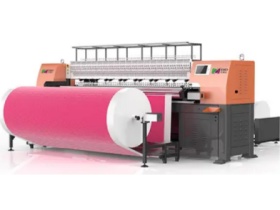
Shuttle hook systems use an oscillating motion, moving back and forth during each stitch cycle. This design introduces directional changes that increase inertia as speed rises. At higher RPM levels, this can limit how fast the machine operates comfortably.
These physical constraints define the typical speed range of shuttle hook machines.
Within moderate speed ranges, shuttle hook Quilting Machine designs perform reliably. Their simpler mechanical structure delivers predictable stitching and stable performance. Many production environments value this consistency, particularly when output requirements remain steady.
For manufacturers not pushing extreme speeds, this reliability supports smooth daily operations.
Shuttle hook systems handle thicker threads and heavier materials effectively. Their looser tolerance allows them to manage larger thread loops without compromising stitch integrity. This flexibility is useful in quilting applications involving dense padding or specialty textiles.
In such cases, controlled performance outweighs maximum speed.
Heavy-duty quilting often prioritizes stitch security over speed. Shuttle hook machines maintain stable stitch formation under load, even when working through thick or multi-layer materials. While overall speed may be lower, consistency remains high.
Priority | Shuttle Hook Performance |
Stitch Security | Remains highly stable |
Material Thickness | Handles multi-layer loads |
Operating Speed | Lower but consistent |
Uniform stitch appearance is essential in commercial quilting. As speed increases, maintaining consistent stitch length becomes more challenging. Rotary hook systems excel in this area, delivering stable stitch formation even at elevated speeds.
This consistency reduces quality-related rework.
Efficient loop formation is critical at high RPM. Rotary hook designs capture thread loops cleanly, reducing skipped stitches and thread breakage. Shuttle hook systems achieve similar reliability by operating within more conservative speed ranges.
Both approaches work, but they support different production strategies.
Modern quilting patterns often involve complex geometry and rapid direction changes. Rotary hook Quilting Machine designs handle these demands with greater precision, maintaining pattern alignment throughout the quilting area.
Pattern accuracy directly influences product aesthetics and customer satisfaction.
Computerized controls allow manufacturers to fine-tune speed and stitch parameters. Rotary hook machines respond predictably to these adjustments, making optimization easier. Their stable mechanics support tighter synchronization between software and hardware.
This integration simplifies scaling production speed.
Continuous workflows reduce manual handling and idle time. Rotary hook systems support uninterrupted feeding, stitching, and discharge processes. Shuttle hook systems often require more conservative settings to preserve stability during continuous operation.
Workflow efficiency depends heavily on mechanical consistency.
In multi-needle configurations, vibration and timing issues multiply across needles. Rotary hook designs minimize these risks by maintaining smooth, balanced motion. This allows multi-needle Quilting Machine setups to operate faster and more reliably.
Lightweight and standard fabrics allow higher operating speeds with minimal resistance. Rotary hook Quilting Machine designs take full advantage of this, maximizing throughput in bedding and home textile production.
These materials highlight the speed potential of rotary systems.
Thick and layered materials increase resistance during stitching. Shuttle hook machines manage these conditions effectively, maintaining stitch integrity even at reduced speeds. In such applications, reliability outweighs absolute speed.
Material characteristics strongly influence optimal machine selection.
Most factories process a range of materials. Balancing speed and control requires understanding how each hook system behaves under different loads. Assigning the appropriate machine to each product type improves overall line efficiency.
Material Type | Recommended Hook Focus |
Lightweight Fabrics | Rotary hook, high speed |
Thick Multi-Layers | Shuttle hook, stability |
Mixed Production Lines | Balance speed and control |
High-volume production environments benefit most from rotary hook systems. Their ability to sustain speed, integrate with automation, and maintain stability leads to higher output per shift. This makes them ideal for standardized, repeat orders.
In these settings, rotary hooks consistently deliver faster production.
Medium-scale manufacturers often balance speed with flexibility. While shuttle hook machines perform well in stable workflows, rotary hook systems provide long-term advantages as order complexity and automation increase.
Consistency over time favors rotary designs.
Utilization rate determines real production speed. A Quilting Machine that runs smoothly for most of the shift produces more than a faster machine plagued by interruptions. Rotary hook systems typically achieve higher utilization, translating into greater practical efficiency.
Production Goal | Faster Hook Choice |
High-volume output | Rotary hook system |
Medium-scale flexibility | Rotary hook advantage |
High utilization rate | Rotary hook efficiency |
Production speed depends on mechanical design, not advertised numbers, the hook system defines how fast and consistently a Quilting Machine performs in real factories. Rotary hook designs lead high-speed, high-volume production through smooth motion, higher RPM, and automation readiness, while shuttle hook systems remain valuable for controlled, heavy-duty applications. Yiboda Industrial Co., Ltd. provides quilting machines that balance speed, stability, and workflow efficiency, helping manufacturers achieve reliable output and long-term production value.
A: Production speed depends on hook design, stability, uptime, and how consistently a Quilting Machine runs during long shifts.
A: Rotary hook systems are faster because a Quilting Machine can run at higher RPM with less vibration and fewer stops.
A: They handle thick threads and heavy materials well, offering stable output when speed is not the main priority.
A: Automated systems favor rotary hooks because they support smoother motion and predictable timing at high speed.
A: No, real efficiency comes from stable operation, minimal downtime, and consistent finished output.


